How the YouTube Algorithm Works Now: Watch Time Is Out, Satisfaction Is In
YouTube replaced watch time with viewer satisfaction as the algorithm's north star. Here is what the shift changes for working creators.

YouTube's recommendation system has two stated goals.
The first is helping each viewer find videos they want to watch, and the second is maximizing long-term viewer satisfaction.
Watch time and click-through still feed the system, but viewer satisfaction now sits above both as the signal that decides what gets recommended.
The practical result is a different playbook for thumbnails, titles, and retention than most working creators are running.
What is satisfaction-weighted discovery on YouTube?
Satisfaction-weighted discovery is the way YouTube currently decides which videos to recommend, with viewer satisfaction signals weighted higher than the older click-through and watch time numbers.
The system treats satisfaction as a predictive signal, because a viewer who finishes a video and feels the time was well spent is more likely to come back to YouTube, and that return is what the recommendation system is built to predict.
YouTube has stated the two goals of its recommendation system on its own Help Center.
The first goal is helping each viewer find videos they want to watch.
The second goal is maximizing long-term viewer satisfaction.
The "long-term" word is doing real work in that second goal, because the system optimizes for whether a viewer comes back to YouTube over months and years, not whether the viewer stayed for one more minute on a given session.
What signals does YouTube use?
YouTube splits the signals it reads into two groups, both are listed in the platform's own documentation on the recommendation system.
The first group is viewer personalization. The system learns what each viewer likes by watching their behavior over time. This includes which videos they watch all the way through, which videos they skip, which videos they mark as "Not Interested," what they search for, what they like or comment on, what channels they subscribe to, and what languages they choose.
The system also tracks what YouTube calls "interest affinity," which is its phrase for the topics, formats, and creators that similar viewers also enjoy.
The second group is content performance. This is the part most creators already think of as "the algorithm." It covers click-through rate, average view duration, likes, shares, comments, and the survey responses YouTube collects after a video plays.
Both groups feed the satisfaction layer, which is the part Rene Ritchie walked through on Threads.
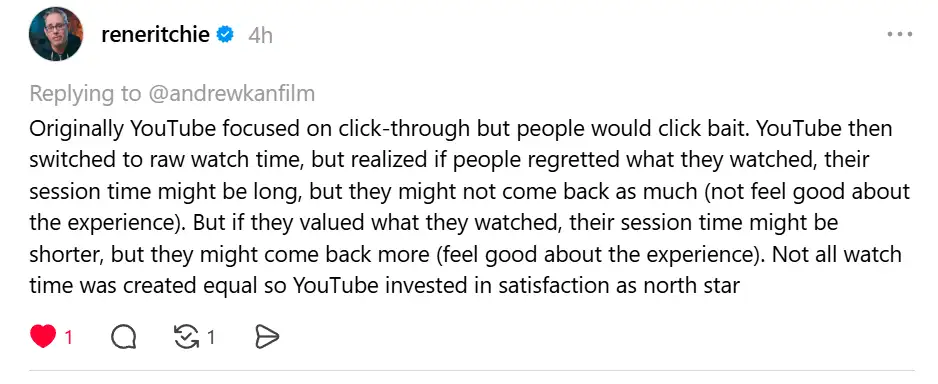
What did YouTube's Creator Liaison say about the shift?
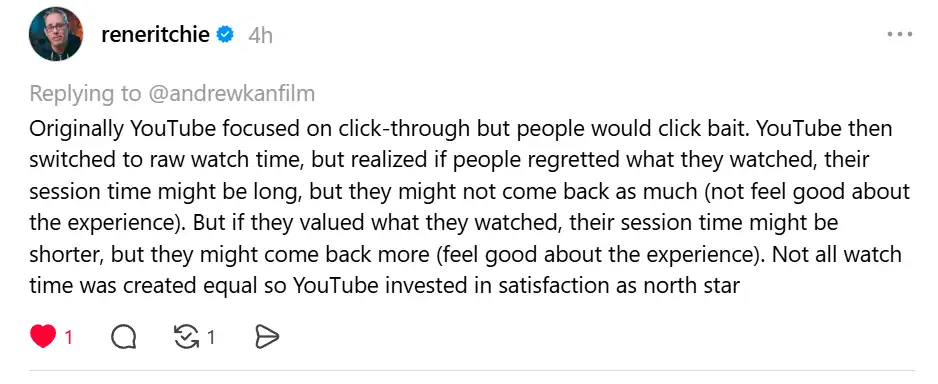
Originally YouTube focused on click-through but people would click bait. YouTube then switched to raw watch time, but realized if people regretted what they watched, their session time might be long, but they might not come back as much (not feel good about the experience). But if they valued what they watched, their session time might be shorter, but they might come back more (feel good about the experience). Not all watch time was created equal so YouTube invested in satisfaction as north star.
Source: Rene Ritchie, replying on Threads
The phrase that matters is the last one. Satisfaction is the north star. Watch time is the older measurement that counts regret as engagement, and the recommendation system is now built around the question of whether viewers come back.
This reframe explains why the clickbait-and-stretch playbook works against creators now. A video that overstays its actual subject reads as a poor experience to the satisfaction layer even when the watch time number looks fine.
The recommendation system reads the same gap when a misleading thumbnail pulls a click that ends in disappointment.

How is this different from the old watch time playbook?
The old advice was simple.
Make videos longer, pad the runtime, pack hooks tighter, and treat watch time as the metric to win. That advice now backfires under satisfaction-weighted discovery.
When a viewer is misled into clicking on a video and sticks around for several minutes feeling disappointed, the watch time graph might still looks fine. But the satisfaction layer reads the same watch as a bad experience and the video gets held back even though the dashboard says it performed.
Click-through rate flipped the same way. A misleading thumbnail still earns clicks, the dashboard still records every one, and the satisfaction layer quietly marks each click as a negative experience when the viewer leaves disappointed.
A high click-through rate on a misleading thumbnail now slows the video down instead of speeding it up.
What does YouTube tell creators to focus on now?
YouTube's documentation gives several specific pieces of advice for creators trying to grow under the satisfaction-first system.
YouTube's first instruction is to focus on the audience instead of the algorithm. The exact line on YouTube's Help Center is to stop asking "Does the algorithm like my content?" and start asking "Does my audience like this?"
Consistency comes next. A sustained presence helps an audience treat a channel as a routine, and a recognizable thumbnail and title style helps viewers spot a video in a crowded feed.
YouTube also points creators at the Audience tab in YouTube Analytics. The tab shows what other channels and content an audience is also watching, which is the cleanest way to spot where the audience is moving.
Publish time gets a caveat. YouTube says publish time has no long-term impact on a video's performance, with one exception. Live streams and Premieres still benefit from posting when the audience is active, because those formats depend on a live moment.
Helping viewers find more content matters. Series, playlists, end screens, and clear calls to action like "if you liked this, watch this next" all work as positive signals to the recommendation system.
Quality is the priority over quantity. YouTube specifically says taking breaks does not penalize a creator, and the platform recommends consistent quality over a high upload rate.
YouTube also wants creators to experiment. The platform treats each video on its own performance data, so one video that does not land does not hold the channel back, and the system still tries to find the right audience for almost every video.
How can you tell if your videos are passing the satisfaction test?
There is no satisfaction score in YouTube Studio, and the survey results are not exposed at the video level. There are still three places that line up with the satisfaction layer's read, and each one is already in the dashboard.
The Audience Retention card is the most readable. A retention curve that holds steady after the introduction usually points to satisfied viewers, and a curve that drops off in the first thirty seconds usually points to an expectation gap the satisfaction layer punishes.
The Returning Viewers number is the second read. A video that pulls returning viewers back at a higher rate than the channel average is almost always one the satisfaction layer is rewarding.
The comment section is the third read. YouTube has trained its system on comment sentiment, so a thread that runs warm tends to point to a video the recommendation system is also pushing harder.
None of these surfaces tell a creator the satisfaction score directly, because YouTube does not expose that score. The combination of them, read together, gets a working creator close enough to the truth to make the next video better.
The YouTube Glossary on the KDCC site covers the definitions for each card.
What should working creators do about it right now?
There are four moves worth making this week, and each one lines up with what YouTube's documentation and Rene Ritchie both point to.
Stop optimizing only for watch time and click-through rate. Both signals still feed the dashboard, and both still matter, but neither one decides whether a video gets pushed anymore.
Treat thumbnails and titles as contracts. Promise something the video keeps, because the satisfaction layer reads the gap between the promise and the delivery, and that gap is where rankings get lost.
Read retention against the topic, not the runtime. A short video that holds attention all the way through outperforms a long video that loses people halfway through.
The YouTube Audience Visualizer on the KDCC site is one quick way to put a face on the audience that is staying versus the audience that is dropping.
Stay current on the framing as YouTube ships the next round of changes on top of this one.
The KDCC newsletter is where the next layer of this story shows up first, written for creators who want platform changes translated rather than narrated. Signing up keeps you ahead of the next adjustment YouTube ships rather than catching up to it three months later.
If I Kan, You Kan Too.