YouTube Analytics, Shorts Strategy, and the Mistakes Costing You Views: My Conversation with Katliente
YouTube Analytics has over 200 metrics. You need 3. I joined Katliente's Creator Accelerator Program to break down impressions, click-through rate, Shorts strategy, and the mistakes quietly costing creators views.

The views you want and the views you get don't always align. Here's what to do about it.
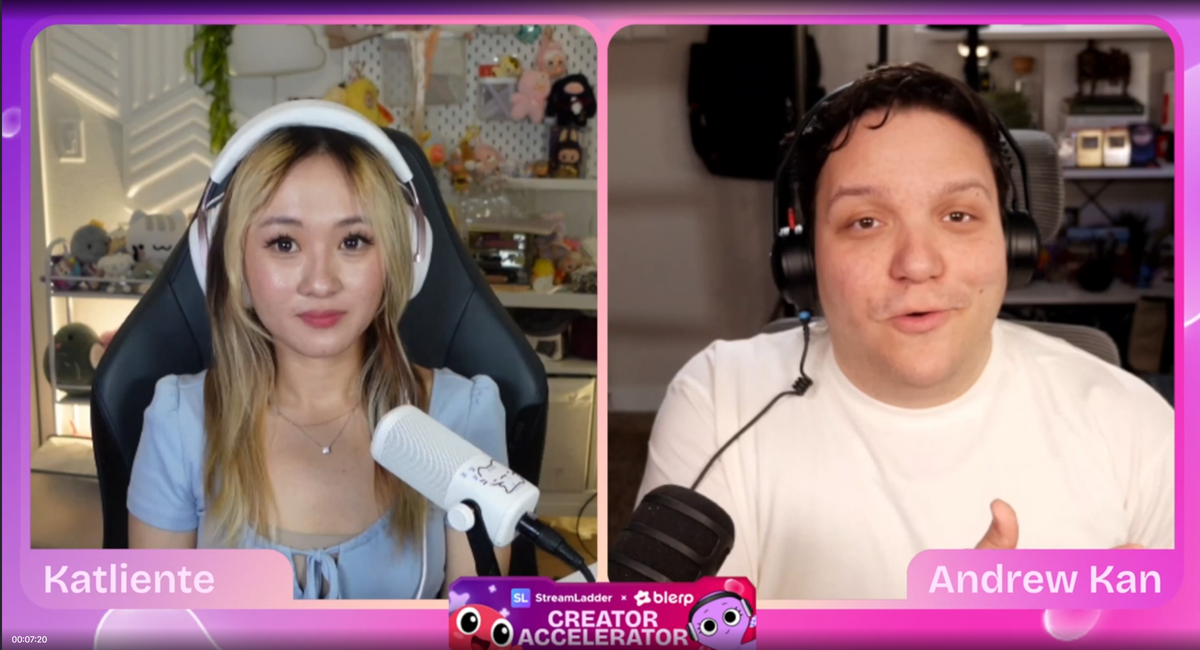
I recently had the pleasure of joining Katliente on her Creator Accelerator Program livestream to talk YouTube growth, analytics, Shorts strategy, and a whole lot more. And honestly? The conversation went places I didn't expect.
I first connected with Kat through our mutual friend Katrina (yes, another Kat, I know) and then ran into her again at an Adobe Express event thanks to our friend Katrina Torrijos. Sometimes the creator world feels incredibly small in the best way possible. After those conversations, I already knew she had a sharp mind for content and community. So when she invited me on to do a workshop, it was an easy yes.
Kat is one of those creators who understands what being a creator is like. She's been creating for years, has built real communities across Twitch, TikTok, and YouTube, and she has this natural ability to ask the exact questions that creators are actually struggling with. Not the surface-level stuff. The real, "I'm stuck and I don't know why" kind of questions. You can tell she's lived it herself, and that comes through in how she hosts these conversations.
What started as a workshop turned into one of the most in-depth YouTube strategy conversations I've had in a while. We covered everything from why your impressions might be low, to how YouTube Shorts actually work, to why your audience might not be ready for the content pivot you're planning.
👉 Watch the full conversation here
YouTube Analytics Has Over 200 Options. Here Are the 3 That Matter.
When Kat asked me where creators should start with YouTube Analytics, I told her the truth: it's overwhelming. Over 200 different metrics, tabs, and data points. It's like opening a game for the first time and seeing 58 menu options before you've even started playing.
But here's the thing. You don't need all 200. You need to focus slowly and build up your familiarity. Here are three to get started:
Impressions tell you whether YouTube even knows how to share your content. If you're not getting impressions, YouTube can't identify an audience for what you're making. That's a signal worth paying attention to, and it often comes down to how literal you're being with your titles and descriptions. YouTube is an incredibly literal system. It doesn't do nuance well. If you're playing a specific game, that game title should ideally be in the first part of your title. If you're teaching something specific, say it clearly.
Click-through rate tells you how well your thumbnail and title are working together. I gave Kat a number to make this tangible: 10,000 impressions is the equivalent of 5 sold-out Broadway shows. If YouTube showed your content to that many people and only a tiny percentage clicked, your packaging isn't converting. That's not a failure. That's data you can act on.
Average view duration tells you whether the content itself is delivering on the promise your title and thumbnail made. If people click and leave quickly, something isn't matching up.
In the full conversation, I walk through exactly how these three metrics connect to what YouTube calls "viewer satisfaction" and why that concept should change how you think about every video you make.
Why Your Videos Aren't Getting Impressions (And What YouTube Actually Wants)
This was one of those moments in the conversation where I could see the lightbulbs going off, not just for Kat, but for the entire chat.
A lack of impressions usually means YouTube can't figure out what your video is about, and here's something most creators don't realize: what you say in your video matters just as much as what you type in the title. YouTube uses your captions and the actual words you speak in the video to understand your content. So if your title says one thing but you never actually talk about that topic in the video, YouTube notices that disconnect.
Kat made a great point here about how this adds context for creators who are confused about their low impression counts. It's not just about your title and description. It's about alignment between every signal you're sending YouTube.
I also shared something during the stream that I think surprises a lot of people: YouTube averages your performance. It takes your highs and your lows and gives you a curve. Some of your content gets tested more aggressively, some less. YouTube is constantly running experiments with your videos, even ones you uploaded months or years ago.
That's actually why some videos pick up traction long after they were published. YouTube has the longest shelf life of any platform. A video can sit quietly for months and then suddenly catch fire because a related topic became relevant. I shared a specific example from the Pokémon community that made this concept click for a lot of people in the chat.
👉 Watch the full breakdown in the replay
Your Hook Isn't Just What You Say. It's What You Show.
Kat asked me about improving hooks when a creator has high impressions and high click-through rate but the views still aren't there. Great question, because most people assume "hook" just means the first thing you say.
It doesn't, your visual hook matters just as much as your audio hook. If you're making a gameplay video and the first 40 seconds are you talking to camera before any gameplay appears, the value proposition doesn't match what the viewer expected. If you promised YouTube tips in 6 minutes but spend the first 5 minutes on something unrelated, a viewer is going to feel like that could've been a much shorter video.
YouTube gives you about 30 seconds to hook someone on a long-form video. On Shorts, you've got about 3 seconds. In both cases, it's not just about what you say. It's about what's happening visually on screen. Text overlays, zoom-ins, previews of the best moments, something that gives the viewer a reason to stay.
In the stream, I broke down specific techniques that creators are using to nail their hooks and how to check your own retention data to see if yours is working. That retention graph doesn't lie.
The YouTube Shorts Strategy Most Creators Get Wrong
This is where the conversation really took off. Kat mentioned that a lot of the creators in the Creator Accelerator Program are focused on Shorts, and she brought up something I think is really important: you can build a massive following with Shorts alone. She mentioned a creator with over a million subscribers who has never posted a single long-form video.
But here's where most creators trip up with Shorts. They post content that's only semi-related to what they do on long-form. And YouTube notices.
If your long-form content is about one thing and your Shorts are about something completely different, you're fracturing your audience. YouTube looks at both. It's trying to understand who you are and who your content is for, and if you're sending mixed signals, it makes that job harder.
The other big mistake? Posting one Short and waiting. Shorts can be more of a volume play than long-form. With 200 billion daily Shorts views on the platform, there's a massive amount of content being consumed. Posting one Short a week puts you at a significant disadvantage compared to creators posting one to three a day.
But, and this is critical, it depends on your audience.
Check This Metric Before You Post Another Short
This was one of my favorite moments in the conversation because Kat had never seen this metric before, and her reaction was priceless.
Inside YouTube Studio, there's a section under Analytics > Audience that shows you "formats your viewers watch on YouTube." It gives you a rating from 1 to 5 for videos, Shorts, and live streams. A 5 out of 5 means your audience is highly interested in that format. A 1 out of 5 means you've got work to do before going all-in.
I've seen creators posting tons of Shorts when their audience is rated 1 out of 5 for Shorts interest. That's an uphill battle. Not impossible, but you need to know you're climbing that hill before you start.
And here's the encouraging part: that rating is recalculated every 28 days. So if you start slow-dripping Shorts into your content mix, building that expectation gradually, your audience interest score can climb over time. I went from a 2 out of 5 for live streams to a 4 out of 5 just by being consistent.
Kat checked hers live on stream and we had the exact same scores. That was a fun moment.
The path from your analytics to this metric, the strategy for interpreting it, and how to adjust your posting frequency based on what you find are all in the replay. It's one of those things that's much easier to follow when you can see the screen.
Titles Need to Be Both Searchable and Compelling
Kat asked me about common title mistakes, and I shared something I learned from Mark Rober at Adobe MAX about 9 visceral emotions that drive people to react to content.
Most creators lean too far in one direction. They're either incredibly search-friendly with titles like "How To Build A House" that are useful but not exciting, or they're super compelling but YouTube has no idea who to show the video to.
The best titles do both.
I also see a lot of creators accidentally spoiling the outcome in their title. If the viewer already knows what happens, there's no reason to click. There's a real art to creating enough curiosity that someone has to find out what happens next without being misleading about it.
We dove deeper into specific examples during the stream, including a Tetris creator who had "Part 84" in the title of a standalone video and why that kind of barrier to entry can quietly kill your discoverability.
The Window vs. The Door: Why New Viewers Can't Find Their Way In
This might have been my favorite analogy from the entire conversation. A lot of creators build content that's like a window. You can see inside, you can tell something interesting is happening, but there's no door to walk through.
If you've been creating content for a while, everything feels obvious to you. You've been there for every single video. But a brand-new viewer stumbling onto your content for the first time doesn't have that context. If your video assumes they already know your inside jokes, your terminology, or the 83 previous episodes, you've accidentally built a wall.
Your community, the people who've already said yes to you, they're in on it. But your audience, the people you want to reach, they need a way in. There's a real difference between those two groups, and the best creators build content that serves both.
I challenged every creator watching to go back and watch one of their own videos as if they'd never seen the channel before. Most of the time, you'll find barriers you didn't know were there. And when I help creators identify and remove those barriers, the response is always the same: "I hate how simple this is, but it works."
Quality vs. Quantity: The Trap Nobody Talks About
Kat asked me the classic question, and I gave her what might be an unpopular answer.
I've seen too many creators use "quality" as a reason not to hit publish. I have a friend who's been working on a single video for 6 years. When I asked her what happens if it doesn't meet her expectations when she finally publishes it, she told me she hadn't thought that far ahead.
That's the trap, the reality is published videos beat perfect videos every single time, because a perfect video that never sees the light of day helps no one. Improving by 1% over time through consistent publishing will lead to quality far more reliably than waiting until something feels "ready."
I'm not saying quality doesn't matter. It absolutely does. But there's a difference between technical quality, like having good lighting and good audio, and the quality of the viewer's experience, which is what YouTube actually measures. And sometimes the video you spent the least time on is the one your audience loves the most.
We had a whole moment in the stream where half the chat felt called out. That's usually a sign you're on to something.
What to Watch For (Without Spoiling the Good Stuff)
There's a lot more in the full conversation that I deliberately didn't cover here, including specific posting time strategies and why YouTube's default scheduling might be working against you, the truth about whether looping your Shorts actually helps (spoiler: it's complicated), the Hero/Help/Hub content framework and how it applies to gaming creators, why "don't forget to like and subscribe" unfortunately still works and when to say it, how to think about monetization differently depending on your genre, and the mental health side of content creation that nobody talks about enough.
Kat is an incredible host. She has this way of pulling out insights that even I hadn't fully articulated before, and the chat was engaged the entire time. I walked away from this conversation reminded why I love doing what I do.
👉 Watch the full Creator Accelerator workshop replay here
About Katliente
Kat is a Twitch Partner, content creator, and one of the most thoughtful voices in the streaming and creator education space. She's been at this for a long time, and it shows in how she approaches everything from community building to the way she interviews guests. Her Creator Accelerator Program is helping creators level up in real, practical ways, and if you're a creator looking to grow, she's someone worth following.
A big thank you to Blerp and StreamLadder for putting the Creator Accelerator Program together and for investing in creators like this. Programs that bring creators together to learn from one another are exactly what this space needs more of.
About the Kan Do Creators Community
If conversations like this are your thing, the Kan Do Creators Community (KDCC) is where we have them every single week. It's a community built on the idea that YouTube doesn't have to be a single-player game. Because the best decisions I've ever made as a creator came from conversations just like this one.
If I Kan, You Kan Too.